Analysis
From June to September, container ships waited at anchor three times as long as last year
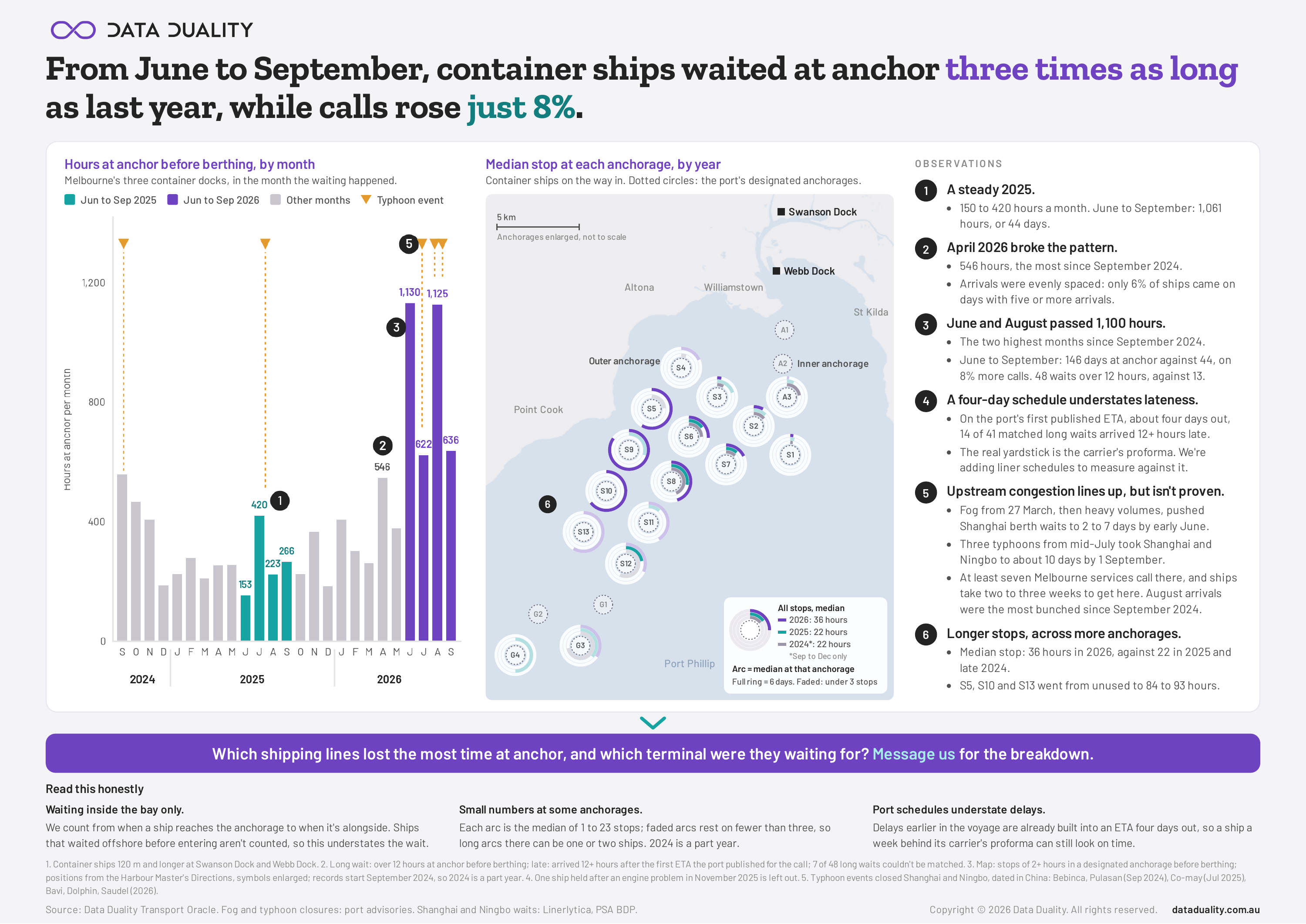
Container ships waiting for a Melbourne berth spent three times as long at anchor this winter as last, on just 8% more calls.
From June to September, two or more ships were waiting at once 28% of the time, against 3% a year earlier, while time alongside per call didn't rise.
How late were they? Against the first ETA the port publishes, about four days out, 14 of 41 long waits arrived 12 or more hours late. That understates it, because delays earlier in the voyage are already built into a four-day ETA. The real yardstick is the carrier's proforma, and we're adding liner schedules to measure against it.
Which shipping lines lost the most time at anchor, and which terminal were they waiting for? Message us for the breakdown.
 (opens the chart full screen)
Tap to zoom
Observations
- A steady 2025. 150 to 420 hours a month. June to September: 1,061 hours, or 44 days.
- April 2026 broke the pattern. 546 hours, the most since September 2024. Arrivals were evenly spaced: only 6% of ships came on days with five or more arrivals.
- June and August passed 1,100 hours. The two highest months since September 2024. June to September: 146 days at anchor against 44, on 8% more calls. 48 waits over 12 hours, against 13.
- A four-day schedule understates lateness. On the port's first published ETA, about four days out, 14 of 41 matched long waits arrived 12+ hours late. The real yardstick is the carrier's proforma. We're adding liner schedules to measure against it.
- Upstream congestion lines up, but isn't proven. Fog from 27 March, then heavy volumes, pushed Shanghai berth waits to 2 to 7 days by early June. Three typhoons from mid-July took Shanghai and Ningbo to about 10 days by early September. At least seven Melbourne services call there, and ships take two to three weeks to get here. August arrivals were the most bunched since September 2024.
- Longer stops, across more anchorages. Median stop: 36 hours in 2026, against 22 in 2025 and late 2024. S5, S10 and S13 went from unused to 84 to 93 hours.
Read this honestly
Waiting inside the bay only. We count from when a ship reaches the anchorage to when it's alongside. Ships that waited offshore before entering aren't counted, so this understates the wait.
Small numbers at some anchorages. Each arc is the median of 1 to 23 stops; faded arcs rest on fewer than three, so long arcs there can be one or two ships. 2024 is a part year.
Port schedules understate delays. Delays earlier in the voyage are already built into an ETA four days out, so a ship a week behind its carrier's proforma can still look on time.
Notes: 1. Container ships 120 m and longer at Swanson Dock and Webb Dock. 2. Long wait: over 12 hours at anchor before berthing; late: arrived 12+ hours after the first ETA the port published for the call; 7 of 48 long waits couldn't be matched. 3. Map: stops of 2+ hours in a designated anchorage before berthing; positions from the Harbour Master's Directions, symbols enlarged; records start September 2024, so 2024 is a part year. 4. One ship held after an engine problem in November 2025 is left out. 5. Typhoon events closed Shanghai and Ningbo, dated in China: Bebinca, Pulasan (Sep 2024), Co-may (Jul 2025), Bavi, Dolphin, Saudel (2026).
Source: Data Duality Transport Oracle. Fog and typhoon closures: port advisories. Shanghai and Ningbo waits: Linerlytica, PSA BDP.